CELERITY SPEAKS
by William Thomas
Bluewater Sailing
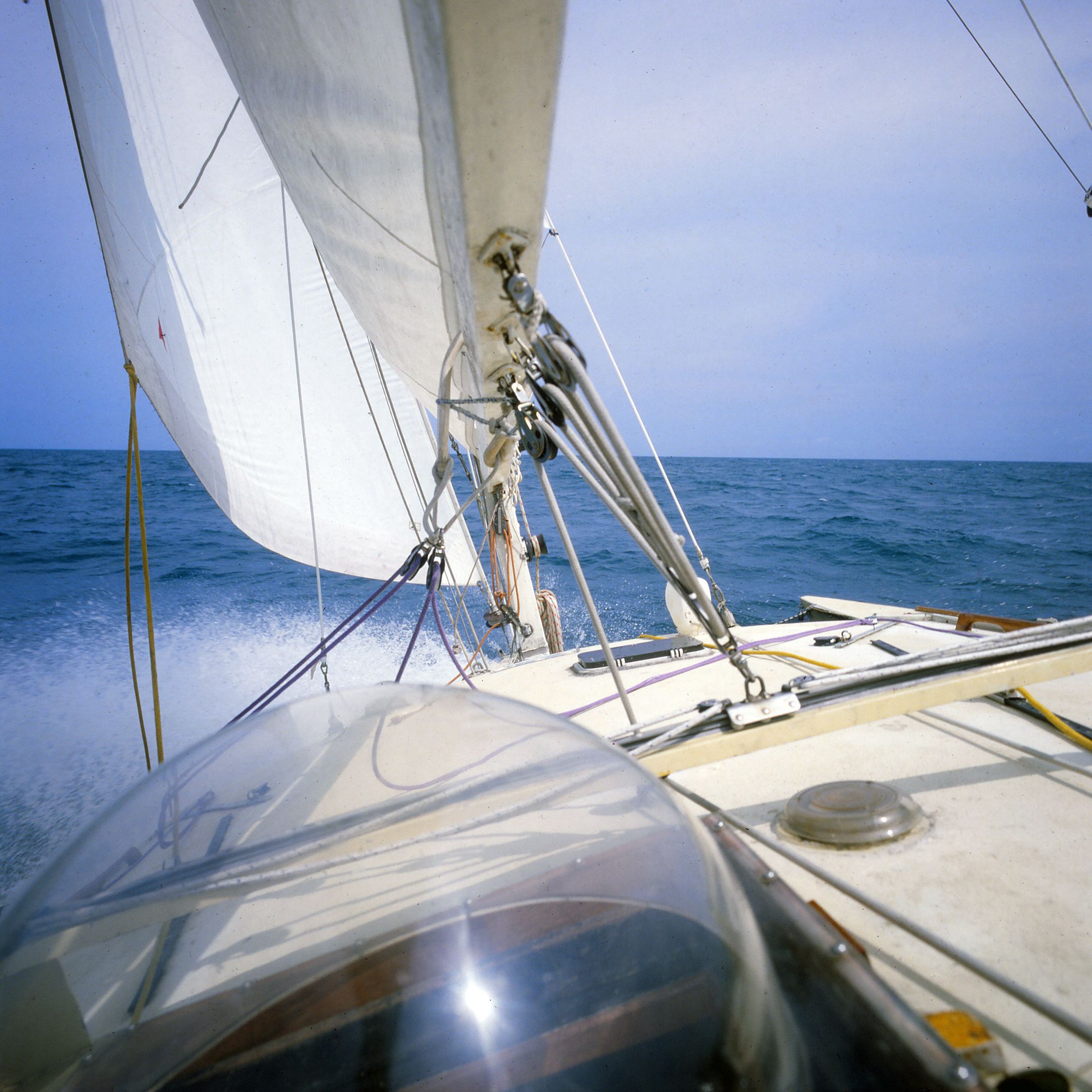
I was born to run forever across the undulating plains of the deep-blue sea. There is joy in my gait, an untamed exuberance that flings rainbows of spray from all three bows. Polynesians call such spirit, mana.
Because I am blind, day and night are all the same to me. My light displacement, spidery construction and native sea-sense respond instantly to every wrinkle in the turbulent interface I navigate, where sky rubs against ocean to form the winds and waves that propel — and sometimes imperil — me.
While I can slot into any seaway if given the right wardrobe, I cannot adjust those sails, scrub my bottom, recover my anchors, start my engine, dodge shoals, repair damage or chart my course. I need my people for that. Just as they depend on me for their next landfall.
And their lives.
Orphaned on Gabriola Island, I converse only with the cedars whose kin form my ribs. Months pass. One day, I sense my builder’s van approaching. Someone new jumps out and runs toward me — then stands stock still, taking everything in…
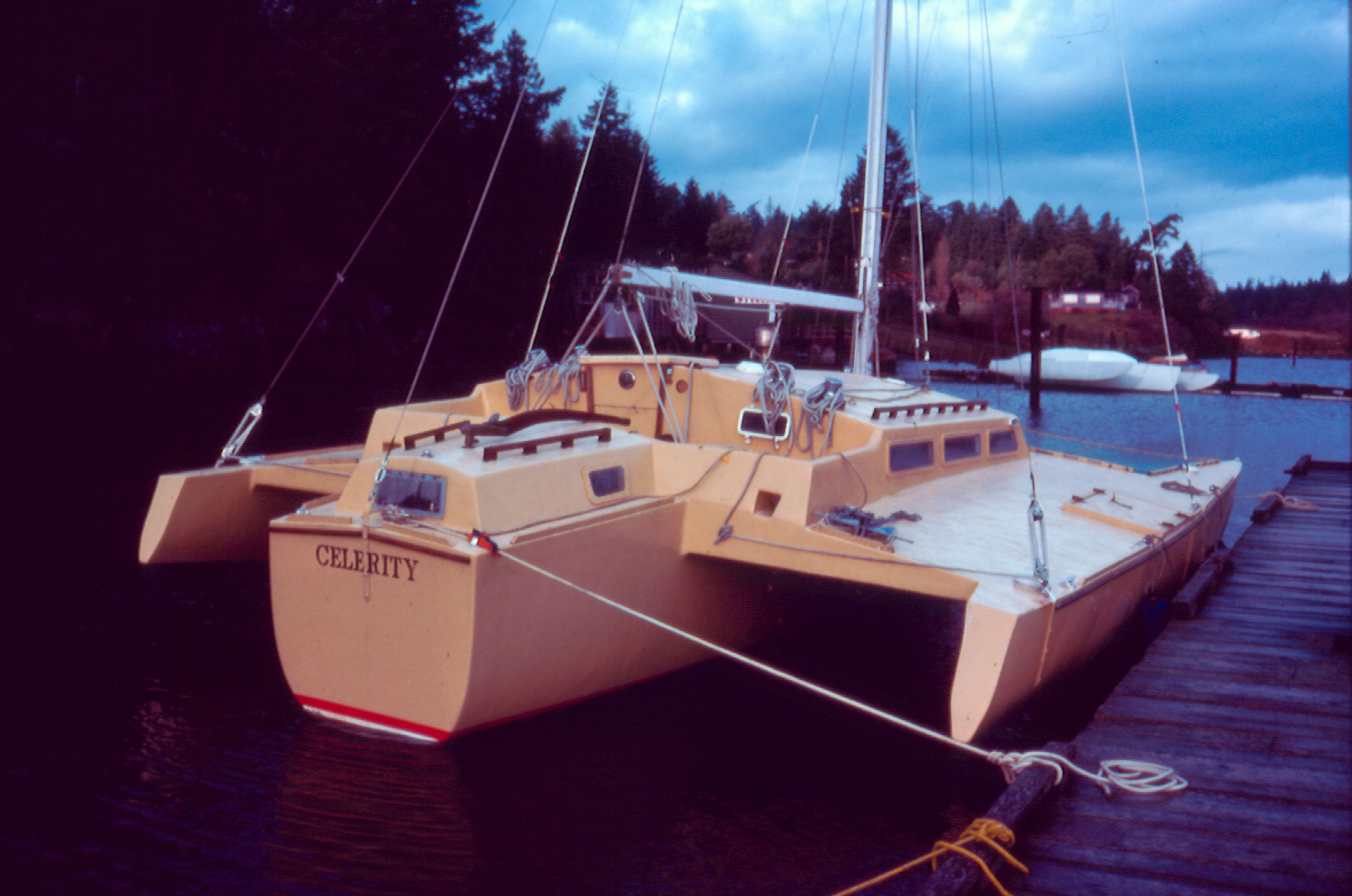
Propped on oil drums at the edge of the forest clearing, tan hulls awash in dappled light, I stand with wings outflung like a seabird poised for flight.
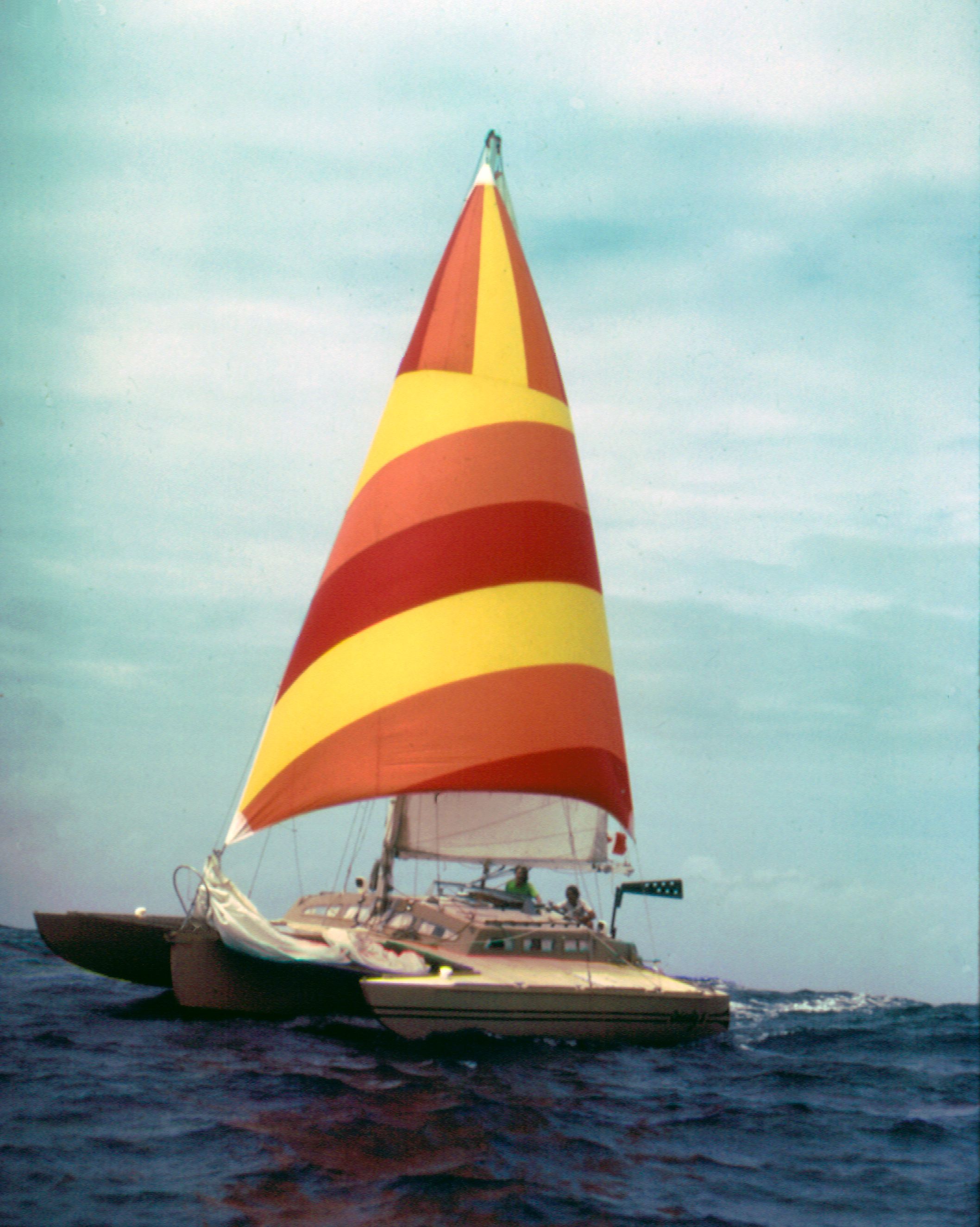
Flanked by a pair of rapier-lean outriggers, cambered decks and low cabinsides accentuate my rakish lines. A nearly-plumb bow gives me a purposeful air, while preserving most of my 31-feet at the waterline.
Guided by a long, shallow fin, my underbody is round and sleek as a dolphin’s. Those full sections aft promise ample buoyancy for surfing.
“Lord,” I hear my suitor breathe, already intoxicated by boat lust and freshly-sawn cedar. “If she sails as good as she looks…”
Designed by a descendent of Vikings, my lineage includes the double-outriggers of Southeast Asia and the asymmetric hulls of Micronesian flying proas. Aussie Hedley Nicol contributed double-diagonal planking. My box-beam crossarms come from Californian Arthur Piver. That Swede up in Haida Gwaii introduced my semi-submersible amas.
Bill Kristofferson’s 90-percent buoyancy outriggers are genius. Acting like shock-absorbers, they depress slowly in gusts — curtseying to spill wind, dampen rolling, and signal when to shorten sail. The former Arabian dhow sailor calls his new class of multihulls: Kismet.
With gumption and funds depleted and winter fast-approaching, on November’s last favoring tide my escape from Svend’s backyard begins with a Mad Max road trip behind an ancient pickup careening along narrow country lanes.
The Scandinavian’s driving. He stops often so my captain can hammer dislodged wedges back between my underwings and the teetering uprights nailed to my borrowed trailer. When the loaner truck’s brakes begin to fade, my desperate master deploys a skittering anchor to slow us down. In two places on Cooper Road, the close-lipped shipwright dismounts to measure one-inch clearance between each float rubrail and massive firs.
With only minutes remaining until high tide, I am poised like a high-diver atop the steep descent into Degnen Bay. My new owner and his recently-converted accomplice unhitch my trailer and start easing me down. Whatever are they thinking?
Skip the champagne. Sensing water, I bolt. As my rickety carriage thunders downhill between a stout fence and jagged ditch, the woman named “Thea” whips her guide-rope around a post.
“Cast that line off!” the captain bellows. And she does.
With their dreams choking on distance and acceleration, I reach the bottom of the slope, buckboard across a smooth rock strand, and disappear beneath an explosion of spray.
Three heartbeats later I reappear, rocking gently in my new Pacific playground — but unable to float clear of that traumatized trailer. Some nudity and hypothermia follow.
When the breeze quits, I sail by sorcery. When it rises to a soul-clutching shriek, I welcome such frolic as fun. Like a mischievous mutt always getting into the garbage, I have an affinity for heavy weather. And an uncanny ability to sniff it out.
Happily for all concerned, the worse the conditions, the more seakindly my motion. I am easily handled, utterly forgiving, and safe as a raft in a blow.
On September 7, 1977, I hang a left at Cape Flattery, hunting the south from northern fjords like a falcon released from the fist.
“Into the infinite,” I hear the mate tell herself when she comes up on deck that first morning at sea to confront majestic rollers whose flashing crests stretch in every direction beyond an ever-receding horizon.
Intimidated by immensity, my sails are hobbled. Like any wild creature, I gripe and balk. Until the captain says, “Let’s shake out that second reef.”
Now aligned perfectly with immense and dynamic forces, I run laughing through the quartering troughs – light, fast, responsive and free.
Someone asks my designer, how did you know? That my buoyant main hull would balloon over the heaviest seas. That my people would stay dry, on deck and below. That meals would be civilized. Even in a blow.
My 30-inch draft enables me to slip over reefs into uninhabited lagoons and anchor serenely inshore. When cash and boatyards are scarce, I can be dried out on a beach for bottom work.
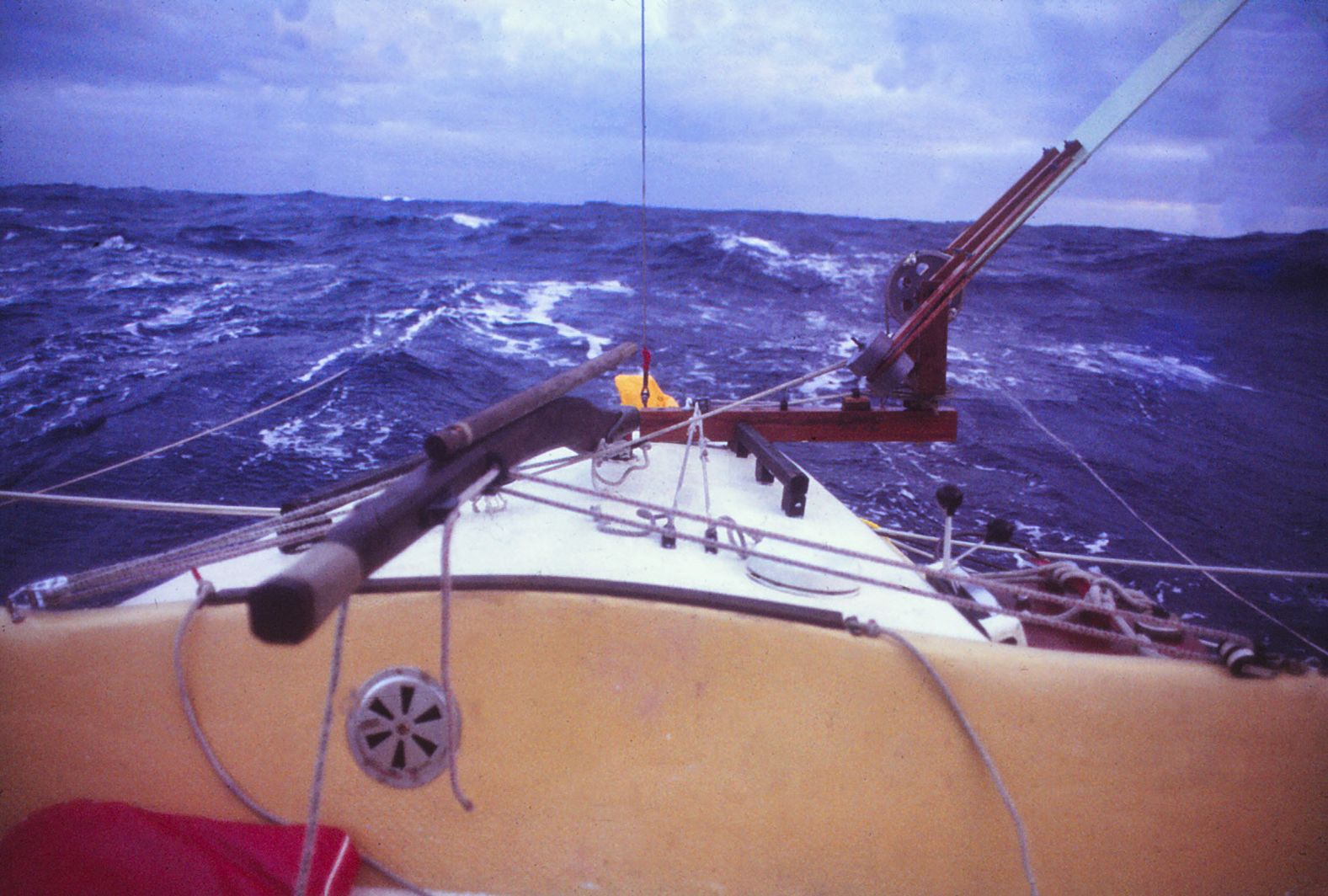
In storms far offshore, Mother Ocean can’t get her grippers on me. Because whenever I get in the way of a fast-freight comber — which is about every nine seconds — my lack of underwater appendages to trip over confers a ju-jitsu-like ability to skip aside.
Still, when this same side-slippage combines with my inability to sail close into the wind, leaving us shy of a unfamiliar port we can’t fetch before dark – shallow draft frustrates all three of us.
So in Rabaul, my captain says nuts to this and orders a full-batten racing mainsail, elliptically-shaped like a Spitfire’s wing.
Next I’m hauled on 3-inch pipe rollers up a concrete ramp behind a snorting tractor into an abandoned wartime seaplane hangar, where the builder of a flawless Wharram catamaran frowns at the fat teardrop pattern chalked on the hangar floor as if personally offended.
“How wide at the widest?” he demands.
My captain takes a long breath. And says, “Thirteen-inches.”
Holy crap! I’m doomed.
A German perfectionist bends and shapes planks of balsa-like Aerolite around my plank-on-edge minikeel to fit an alarmingly bulbous outline chalk-marked on the hangar floor.
“You sure you want to do this?” Dieter asks.
Halfway back down the ramp behind a snorting tractor, I slip off the pipe-rollers, with one wing in the shallows. A shift of New Guinea workmen put down their lunch, walk over, pick me up at the bows, and set me in the water.
I now sail upwind with authority. Plus, the additional three-inches I pop up on my waterline means an additional 500-pounds of payload!
Despite three hulls to stow stuff, “Thomas” has flown enough to respect the weight-and-balance limitations of a vessel more akin to a light aircraft than a conventionally-ballasted keelboat.
Overloading a trimaran kills performance and compromises safety. My friends Bright Wing and Ocean Rover crack their underwings beating into Tonga. The 38-foot Akahi punches hers out going into Hawaii. She floods and is nearly lost.
This welterweight’s strategy is to ride over the waves. And not tip over. Or come apart. As my detractors constantly warn.
Bad-mouthing someone’s vessel is bad form. But my modest displacement and functional backyard construction panics sailors and shipwrights suckled on varnish and centuries-old customs and tech. In Suva, one skipper confided to another, “I wouldn’t leave the harbor in that boat.”
Another owner of a pretty pocket yawl whose low freeboard could pose risk in a bathtub, leaned toward my captain. “Tell me,” he implored. “Didn’t you ever consider safety when you chose your boat?”
Here’s the thing boats only talk about among ourselves, when we get together in crowded anchorages. Contrary to man-against-the-sea mythology, instead of conferring strength, the sluggish inertia resulting from massive scantlings, deep keels and lead ballast leaves heavy “traditional” yachts vulnerable to knockdowns by collapsing breakers the size and tonnage of fast-moving apartment blocks.
Better to jump aside.
Weighing in at 4,300 pounds bare-naked, my two criss-crossed layers of 3/16-inch plywood planking are hell-for-stout. I survive two serious groundings, five-days of Force 10 off the notorious Washington-Oregon coast, a 90-hour hurricane off Point Conception that sank a nearby ship, and Freida’s translucent combers south of the line. The trick is to be the beachball that doesn’t get swallowed.
An expeditious passage confers safety. Shorter time en route means less exposure to shipping, squalls and stormfronts. More importantly, every sailing vessel has her pride. When a cruising boat sails in out of the blue, her last port is the first question everyone asks.
The next: “How many days?”
On a good one, the salty Tahiti ketches my master once coveted can cover up to 100 sea-miles. Sailed conservatively on a similar waterline – often under deep-reefed mainsail – I average 165.
Making for the Marquesas, running off before a glorious blue-sky gale I log 180 sea-miles noon-to-noon.
Setting out from Vava’u the same morning as a gorgeous 37-foot Swan, we raise Totoya Island at noon the third day. Wishing to clear neighboring Moala before dark, my master holds onto sail.
In a freshening breeze, with big following seas smoothing into long unbroken slopes, we play “catch the crest”. Each time my speed becomes synchronized with the next wave heaping up astern, I surf for over a minute.
“SeaDAWG!” screams the captain, pounding my cabintop as strong vibrations cycle up through bare feet and the tiller in his hand. Every time my amas lock in, passing through 15-knots, the woman standing with him whoops and hollers, too. Safely past both unlit islands when the wind hardens at sunset, we turn north and run off.
The owners of that Swan – with her skybreaking mast, fancy fittings and price-tag fit for the Riviera – arrive in Suva bragging of their fast passage. Until learning that a humble homemade trimaran from Canada has preceded them by a full day.
Much later, sailing home across the top, timely weather tracking allows the navigator to position me above approaching Lows, riding with wind and seas at our backs. Instead of bashing into it.
The smallest trimaran to complete a 40,000-mile Pacific circumnavigation, I am the first multihull in history to make the nonstop passage from Japan to North America.
Not bad for an orphan.

Photo Captions
Celerity westbound in a hurry -(R) Will Thomas photo
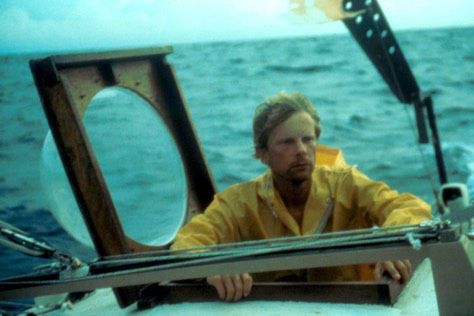
Tuckerd Thomas five days out ofPonape -Thea Mortell photo
Bare-bones, engineless Celerity soon after launching at Silva Bay, Gabriola Island -Will "Randy" Thomas photo
Running off towing a tire drogue 120 miles off the Oregon coast -(R) Will Thomas photo
Celerity under jenniker off Suva, Fiji -Thea Mortell photo
Celerity anchored off ancient O'torii under repair at Miyajima Island, Japan -(R) Will Thomas photo