FIRST SOLO
by William Thomas
Flying
Cessna's renowned leaf-spring landing gear is virtually indestructible. Which is a Very Good Thing for student pilots who grow ground shy as unyielding concrete looms. "Landing" several feet in the air and letting the airplane drop like a garbage can full of loose rocks makes a large, ego-shredding noise...
Pilots say that any landing “you can walk away from” is a good one. My latest "arrival" must qualify, because as we come to a stop Mary Creason is already exiting the aircraft — on the runway with the prop still turning!
"You're ready," my instructor shouts from the safety of the tarmac. "Take it around for a full stop."
The door slams. And I am alone in a way I have never felt before.
The madmen in the control tower must be in on the conspiracy, because they clear me for takeoff. Standing on the toe brakes, I advance the throttle all the way to the panel.
The mostly-unmuffled hundred-horse Continental roars. Unfortunately, oil temperature and pressure remain in the green. Take-off trim is set and I've already retracted the flaps and checked both cockpit doors secured. In a kind of resolute daze, I release the brakes.
And we are rolling. Propeller torque wants to pull the nosewheel off the fleeting centerline. But I'm already pressing the right rudder-pedal to compensate. As speed builds to 55 knots, I feel the wings in my hand start to cup the air. At 60 knots, I pull back on the control wheel...
The ground drops away.
I am FLYING!
Me myself!
Alone in an airplane!
I am 16. Too young to legally drive a car.
Briefly leveling off to gain airspeed, I recommence the climb-out at 80 knots. With only one small person onboard, the Cessna climbs like a fighter jet.
Or so it seems to me.
Throttling back to spare the firewalled engine, I belatedly correct for a slight crosswind as Lake Michigan pops into view ahead. At 500 feet, I move my hands and shove the "Big Lake" aside, commencing a 90-degree left turn, still climbing. Engine gauges still happy. And a planet dropping away below me.
Looking down at the oddly motionless tire beneath my door, the airplane appears to be stationary while the ground slowly unscrolls below.
Still in shock, I am too busy to be anxious. And just as I become more relaxed sailing into deep water away from shore, I'm feeling better as this homesick angel heads for deeper air. Altitude means time and options if the engine quits.
Altitude is life.
I level off at 1,000 feet. Once-familiar rural Michigan is a dollhouse of shrunken houses, toy cars and daisy-like trees. I always revel in this God-like perch. But I am an interloper here and there is no time for sight-seeing.
Somehow, I've executed another left turn onto the downwind leg and am flying more or less straight and level, more or less parallel to the 6,500-foot runway sliding past off to my left. It seems fantastic I will alight there. But that's the plan.
I key the mic. "Muskegon tower, Two Two Tango downwind for full-stop."
"Two Two Tango, cleared to land runway two-four. Wind calm."
"Two Two Tango."
I am not bored yet! The engine note drops as I apply carb heat and slow to 80 knots. Reaching down to the big lever protruding like a parking brake from the floor on my right, I pull on one notch of flaps, applying firm forward pressure with my other hand to prevent the nose from popping up. Meanwhile, the runway has coyly retreated behind my left shoulder.
Rate-of-descent flickering around 500 feet-per-minute and I try to pin it there as I apply left rudder and tilt into another left turn. Rolling out on the crosswind leg, the end of the runway reappears ahead and off to my left, now at a right-angle across my track as I complete the racetrack "pattern".
As we continue the descent, details below snap into sharper relief. I close the throttle. The near-silence is eerie. Only the now-audible rush of the slipstream indicates we are coming down.
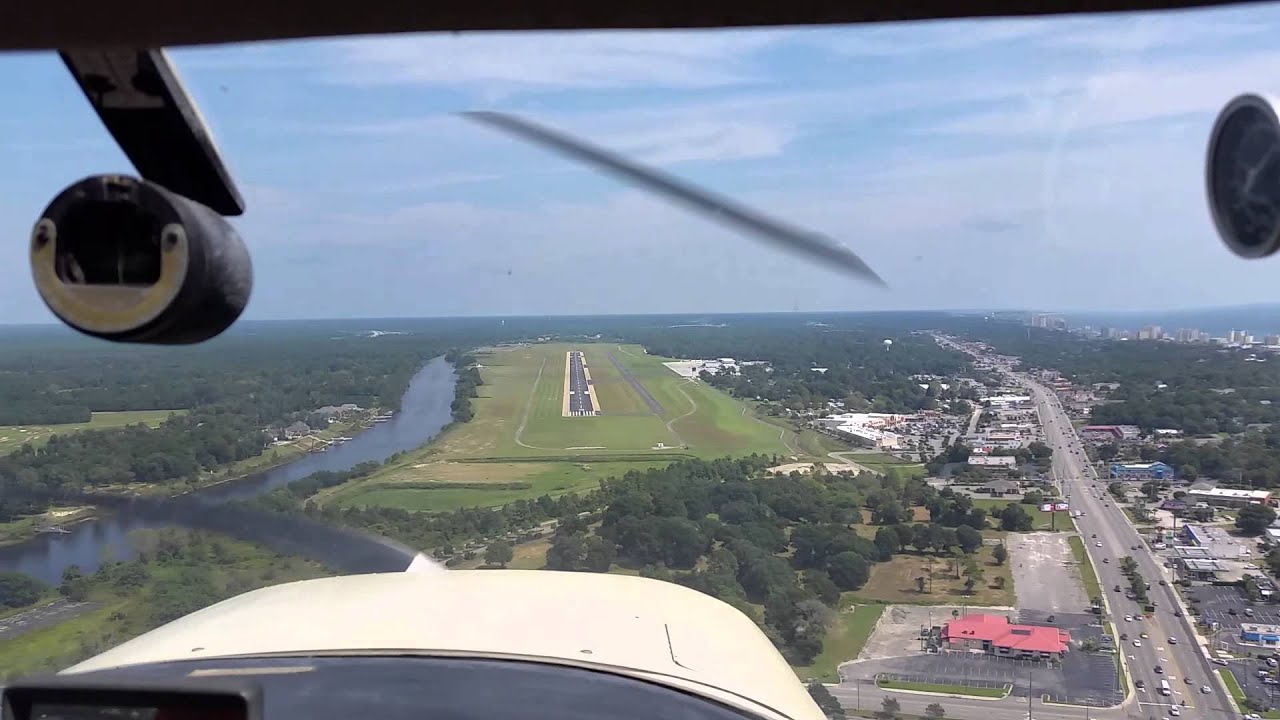
I turn onto final, watching my airspeed like any hawk. As I line up with the runway, it appears to sink from under me. I'm high — in every sense. But not for long. Slowing to 65 knots and holding the nose firmly down, I pull on full flaps. The airplane sags as Cessna's "barn door' Fowler flaps slide out and aft to dam the slipstream. Without looking, I reach down to the trim wheel, rolling it forwards until most of the control pressure neutralizes.
"Hanging in my straps," we are diving like a Stuka, the ground coming up fast. Pre-emptively holding the nose down, I apply full power — "clearing" the engine — then come back to idle. Shock-cooling the engine too quickly in descent can crack cylinder heads. The engine may not respond when needed.
We aren't "stationary" now! At 55 knots, the runway jumps up to fill the windscreen. Against every instinct of self-preservation I continue this seemingly-vertical dive. I mean, standard full flap approach.
Down... down...
Closer...
Too close!
MyGodwe'regoingto...
Now.
Back on the wheel — KEEP COMING RIGHT BACK — as the baby airplane slows and flares just above the fleeting asphalt. At least I hope so. With the nose pitched up, all I can see ahead is bright red cowling. (Pilot's note: "hope" is not a proper flying term.) The stall warning horn blares in fright: BEEEP – BEBEEP BEEP BEEEEEP. We are about to lose lift and fall from the sky!
Except we are already on the ground.
I never feel the wheels touch. No lurch, no bounce, no chirping tires. Swooping out of the sky, we are rolling along the pavement in an absolutely seamless transition.
It is the best landing I will ever make.
Until years later, when it will really count, at Victoria International.
This story first appeared in my column, "From The Eagle's Nest" in the Island Grapevine
Photo Credit
Cessna 150 on final approach -youtube.com