JUMPER!
by William Thomas
You might think that your first parachute jump will be the hardest Think again...
I promise that your first parachute jump will be as frightening and disorienting as licking a tab of acid. Or sailing offshore for the first time. At least, that was how it was for me.
LSD doesn't even come close.
Deep in shock, I had acted purely by the reflexes drilled into me over a morning of practicing aircraft exits and landing rolls from the back of a parked pickup truck.
Stepping out of a perfect good airplane, I had hung onto the airplane’s right wing-strut like a barnstorming stunt man, legs streaming back in a hurricane-force breeze.
Since there was no possibility of clambering back inside the solidity of the fuselage, I’d simply let go. And hoped the static line fastened to my ripcord actually worked.
It did.
When it comes to doing crazy stuff, I must be a slow learner. Because once again I find my silly self on the vibrating floor of that same Cessna staring out at… nothing.
That’s right. The entire right side of the plane's cabin has been replaced by Earth and sky. That’s bad enough. Then the pilot banks steeply to the right to assess the long weighted teamer dropped by the jumpmaster to gauge wind and parachute drift.
The engine's so loud it sounds like that four cylinder Continental is inside my skull. Even with two parachutes strapped to my quavering body, I fear falling out.
Wait. Isn’t that the whole point of being up here?
The good news and the bad news is that it doesn't take long to reach 3,000 feet over the Wisconsin countryside, about an an hour's drive out of Milwaukee by Austin Healey Sprite.
It’s the summer of ’67 and I'm attending a makeup university class in algebra to become a naval aviator. A skydiving friend suggested this weekend diversion. "You gotta try it," he urged. He actually called jumping into the sky thousands of feet up, "fun".
Without warning or preamble, the pilot chops the power and pulls the nose up. Slipstream and airspeed drop off rapidly. The jump master yells, “Stand by!” And before I can stop myself, muscle memory kicks in.
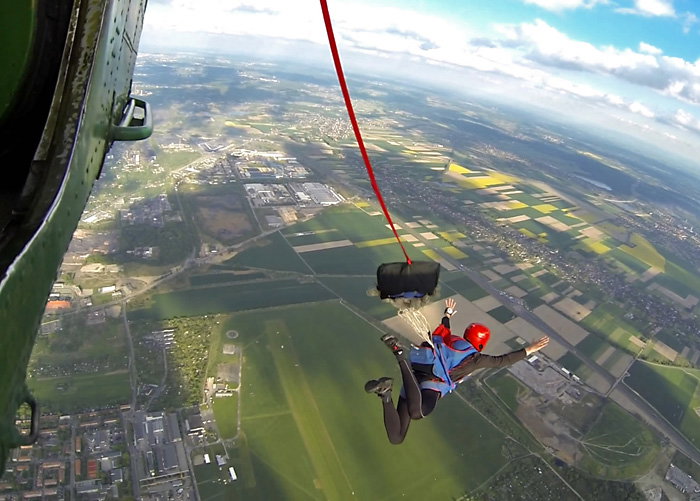
Leaning out into a 60-knot gale, I grab the wing strut with both hands and swing outside the airplane. My legs stream back like Superman as I cling to that aluminum crutch with the avidity of a drowning man clutching at the only solid structure within reach.
Only then do I realize what I've done. Again! As my gibbering brain catches up with my robotic body, a glance to my left shows the sanctuary I’d just abandoned indelibly out of reach.
You've really done it now, ace.
"GO!!!!" screams the jump master.
Without further reflection, I let go. The Cessna jerks upwards, whisking out of view like a conjuring trick.
And then I’m falling.
Air-swimming for my life, more precisely, as that archaic arboreal fear of falling from a lethal height energizes all four limbs to get a grip on… nothing. Unlike swimming in actual water, all this frenetic arm and leg pumping fails to keep me “afloat”.
Screaming the elapsed seconds with all the atavistic terror stored in my DNA, I count down what could be my last seconds on Earth. I mean, sky.
“One one-thousand! Two one-thousand!”
I’m already falling at terminal velocity. If my chute proves coy, I will be arriving at the ground in another 30 seconds.
I've been instructed that if I hear myself shouting “10,000!” and my main chute has still not deployed (a near impossibility since its ripcord is firmly attached to the inside of the fuselage by a long static line) — instead of freezing up in blind panic, I’m supposed to calmly pull the smaller reserve chute clipped to my chest.
Belay "calmly"! Just deploy your reserve without further delay, I was told.
Or go splat.
“5,000!”
I learn why my instructor devoted so much time adjusting my parachute harness when a giant hand jerks my crotch hard enough to risk castration. Ouch! And then I'm literally sitting on the air like a sky god on his throne perched high in the sky.
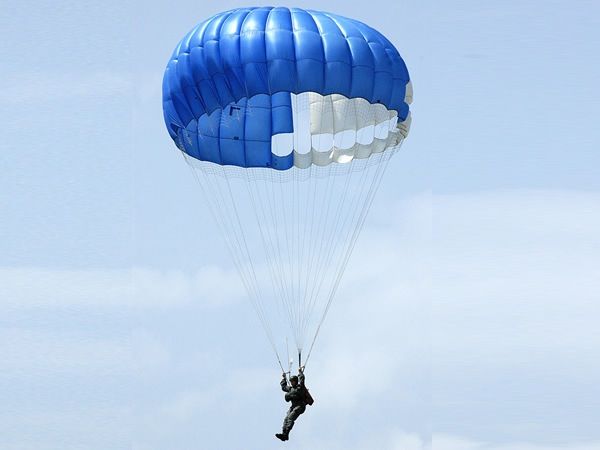
This cloud-like sensation is beyond description. I'm speechless with gratitude to the "silken angel" grasping my mortality in its fingerlike shroud lines.
The only "downside" is that this feeling of floating thousands of feet above the state of Wisconsin lasts only until I look down. Turns out my small training parachute is not a cloud. And the ground is coming up very quickly indeed.
My ground instructor had insisted that at tree-top height I lock my eyes on the horizon. If continue looking down in growing fear and consternation, I will reflexively freeze up just before smacking into old terror firma. That’s when things tend to break. Like leg and ankle bones. Or my spine if I land on my butt. Then the rest of my skydiving will be done in a wheelchair.
Or without a body.
Still, there is absolutely nothing to worry about. Since I am already down! Descent from those last 50-feet does not happen fast. Touch down is instantaneous. And don't even think about executing one of those pretty “landing rolls” you practiced during a hour of ground school. You will be sprawled on the ground before you can form another thought.
Happily, by dutifully tacking my baby parachute in the direction of a big red arrow positioned by an instructor who is gauging my wind drift from the ground below, I perform a skydiving club first by accidentally hitting the peat "bull's eye" in middle of the landing zone. To everyone's amazement — especially mine! — I arrive back on earth in a feather pillow.
Am I getting the hang of this parachuting thing? Or is this beginner's luck?
The next jump is much, much worse. Because I'm no longer in shock, I know exactly what is going to happen, right up to the moment I throw the jump plane away. Then my fate is in the hands of the sky devas. And the rigger who packed both chutes.
Once again, I exit the airplane cleanly. And once again, my main chute opens norma...
Whoa! Something's wrong. Reaching up for both steering toggles, I find that one of them is missing!
Looking up to check my suddenly treacherous parachute, I find almost everything in perfect order. The wooden left-hand toggle is already gripped by that hand. But the righthand toggle that steers my chute by partially collapsing that side and skidding me sideways is… missing in action.
Oh bad!
That's it up there, coyly wrapped around a riser five or six feet above my head. Without pausing to freak out or devise some kind of elaborate response, I instinctively grab a double fistful of shroud lines. And start climbing.
Back on the ground, my instructor is providing a running commentary while watching through binoculars. As if slipping off a high ledge, the smile slides off his face.
“What is he doing?” he address a small circle of onlookers.
Then he grins as he figures out what I’m trying to accomplish. And why.
Good boy!
Within seconds I’ve untangled the errant steering toggle and climbed back down into my easy chair. I’m a hero. A total genius. A brave young man on a flying trapeze. Except this time, I miss the landing circle entirely.
I am stunned by how hard the ground is. And how violently I smash into it. Shaken by the afternoon's entertainment, I’m gathering up canopy and shroud lines when a former paratrooper comes screaming past at head height.
He’s supposed to direct the two long slots sewn into the back of his big Commander parachute to steer into the wind for an easy stand-up landing. Instead, this veteran jumper comes in hot downwind, gambling everything and beers all around on hitting the target.
If he overshoots that fleeting aiming point, the formula of his doom becomes brutally simple: Wind Speed PLUS Parachute Speed = Serious Bodily Damage.
Just ask the club member standing next to me on crutches after landing on a nearby roof. Before continuing on to the ground sans an inflated chute.
Traveling at what appears to be supersonic speed, our reigning club stud with thousands of jumps under his shroud lines, misses that circle of peat salvation completely.
The guy standing beside me gapes as the ex-army jumper zooms past, landing hard enough snap multiple bones in his legs, ribs and back like swizzle sticks.
He does not get up.
He does not win a free beer.
Someone calls an ambulance.
I complete two more practice jumps. The next one hemmed in by scary black thunderstorms as the plane's crackling radio warns of a tornado in the area — the air so saturated with moisture I land light as a proverbial hawk feather.
My first free fall is coming up when I watch the protesting father of a 13-year-old girl being bullied into making his first jump without a static line. Side-by-side his daughter and I anxiously watch together as he exits the airplane.
And falls.
And falls.
And falls...
No chute.
I want to throw up. And lynch the club's bullying "safety" officer. At the very last second before impact, his daughter turns away.
And misses seeing his parachute blossom. One swing. Two. And then her father is on the ground.
Safe.
That's it for me. From now on, I will stay inside aerial conveyances flying contentedly through the ocean of air we so blithely call the sky.
Preferably at the controls.
Photo Captions
1. Static line skydiving training in Wisconsin -wisconsin skydiving center.com
2. Training parachute jump -pinterest.com